Showing posts with label Heritage Travel. Show all posts

Thursday, December 29, 2022

Treasure in Chennault, Georgia

While visiting Washington, Georgia, Sarah (my heritage travel partner) and I traveled northeast to the area known as Chennault.  Our purpose was to trace the route used by Jefferson Davis as he fled from Virginia.  Little did we know that Chennault had significance beyond Davis’s passing.

Chennault takes its name from the family who lived and planted there.  A plantation house at the corner of Elberton Road (GA 79) and Graball Road (GA 44) once belonged to Dionysius “Nish” Chennault, a 300-pound Methodist minister who was also a planter. 

While the house has had wings added to the side and rear over the years, it is listed on the National Register for its architectural as well as social significance.  Built shortly after 1850, it is a five-bay, two-story, late Greek Revival frame weatherboard house with high pitched gabled roof, a full width two-story portico and two central chimneys, serving eight interior fireplaces.  The photo below shows the house in 1976 – the year of its nomination.

Chennault Plantation House c. 1976

Part of its architectural significance is its relationship with three other houses – all within six miles.  The houses are of remarkably similar style suggesting a single master builder, and all were nominated to the National Register.  Part of its social significance is from Jefferson Davis and other Confederate officials passing nearby on the morning of May 3, 1865.

The Chennault property also has the unique significance of witnessing two raids on the Confederate treasure.  The treasure had two parts – specie and jewels belonging to the Confederate government and precious metals belonging to the Bank of Richmond. 

The wagons carrying the treasure – some called it a treasure train – traveled to Georgia with and behind the fleeing Davis party.  On May 4, 1865, at Chennault, unpaid Confederate troops demanded immediate payment from the Secretary of War General Breckenridge.  Breckenridge acquiesced with later ratification by President Davis.  The remainder of the Confederate treasury along with the precious metals belonging to the Bank of Richmond continued on to be held at the Bank of Georgia in Washington.  

Twenty days later, on the night of May 24, 1865, Union troops were not-so-secretly returning the Bank of Richmond metals to the north. They camped at Chennault for the night. Confederate raiders, some say Tennesseans, attacked as night fell.  Much of the bank’s gold and silver was carried off, though bank employees recovered about $40,000 that had been dropped in the dark the next day.

Local legends say the name of route GA 44 near Chennault is a result of this raid.  Graball Road was where you would “grab all the treasure you can.”

Some say parts of both treasures are still missing.  Some is said to be buried at Danville, Virginia, some buried at Chennault, and some moved to other locations.  Entire books have been written and reality TV episodes produced on the whereabouts of the lost treasure.  One TV mini-series even searched the bottom of Lake Michigan.

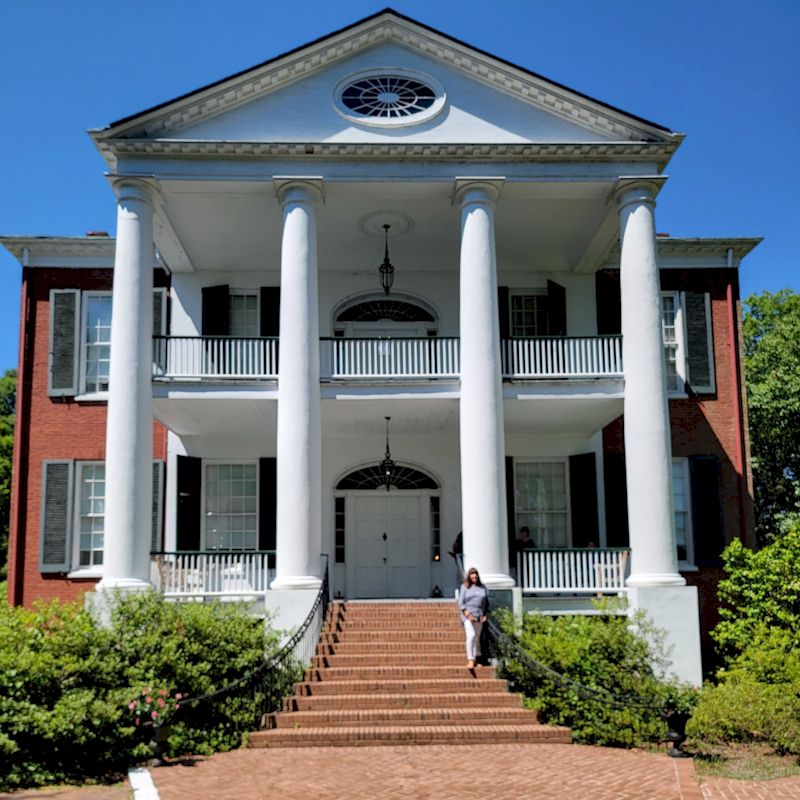
The pastoral Chennault house today belies its exciting history.

Chennault House 2022
Sources:
Carroll, J. Frank; Confederate Treasure in Danville (1996)
Davis, Burke; The Long Surrender (1985)
Williams, Vinnie; Legends surround old homes named to national register;
       Augusta Chronicle-Herald (September 5, 1976)
Willingham, Robert M. Jr.; The History of Wilkes County, Georgia (2002)


Monday, July 18, 2022

Ocean Springs, Mississippi

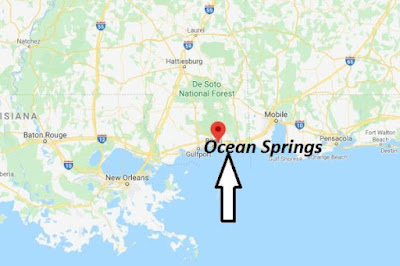
Where Is Ocean Springs
Commissioned by French King Louis XIV, Pierre LeMoyne, Sieur D’Iberville, explored the upper Gulf of Mexico in 1699. He first located what we now call Ship Island about twelve miles from the mainland. He then sailed into a bay where he spotted a high, defensible bluff. There he founded Fort Maurepas, the first capital of the French Louisiana Colony.  The surrounding area and the bay into which he sailed was called Biloxy after the local Native American tribe.

In 1720, the area we now know as the City of Biloxi was settled for the first time. The original settlement across the bay was known as Vieux Biloxy or Old Biloxi. In 1811, the area became part of the Mississippi Territory, with Mississippi becoming a state in 1817. 

In 1854, Old Biloxi, the site of Fort Maurepas, became known as Ocean Springs because a New Orleans physician believed the local springs had medicinal qualities. Many tourists visited the local spas.

In the early stages of the Civil War, Ship Island was captured by Union forces, enabling them to take control of the area. No major battles were fought in the area saving Ocean Springs from direct damage from the war.

In 1870, the Mobile to New Orleans railroad came to town returning Ocean Springs to a tourist destination. It also allowed the easy shipment of Ocean Springs’ seafood to regional markets.

US 90 Bridge 2005

Life changed again in 2005 because of Hurricane Katrina’s 28-foor storm surge. The US 90 bridge from Ocean Springs to Biloxi was destroyed as were many bay-front estates, homes, and businesses.

Downtown

The town has a reputation as an arts community. Its historic downtown streets are lined by live oak trees. It is home to several art galleries and over 150 shops, boutiques, and restaurants. There is nightlife in abundance.

The Office Bar & Lounge

My favorite spots are The Office Bar & Lounge ($3 happy hour) and Maison De Lu for its Escargot Stuffed Mushrooms. They’re amazingly good. I also get to visit my daughter and grandson who have chosen Ocean Springs as their hometown.

Maison De Lu

Just before our visit in June 2022, Ocean Springs was named the best small coastal town in the United States by USA Today. Well-deserved in my opinion.

Ocean Springs is also an excellent stepping-off point for other Gulf Coast communities and attractions.  Both New Orleans and Pensacola are less than two hours away.  The luxurious Biloxi casinos (I like the Beau Rivage) are just minutes from Ocean Springs.

Presidential Library

For the Confederate history buff (like me), the retirement home and library of President Jefferson Davis are also located in Biloxi. It was here at Beauvoir that Davis wrote The Rise and Fall if the Confederate Government. Beauvoir barely survived Hurricane Katrina in 2005 and much of its collection of artifacts was lost. The adjoining library was replaced with a new building that has a bit of an empty feel. Excellent guided tours of the mansion are available every day.

Beauvoir Mansion after Katrina
Beauvoir Mansion Today

Thursday, July 14, 2022

Welcome to Natchez, Mississippi

Cruise riverboat docked Under the Hill

Natchez proper sits on bluff far above the Mississippi River.  However, Natchez was founded in 1716 in an area called “Natchez-under-the-Hill” at river level.  This area was once the rowdiest port on the river – now sometimes called “Natchez improper.”  Like the steamboats of the past, riverboat cruises now dock under the hill.

At the time of the American revolution, Natchez was recognized as Britain's fourteenth colony.  Much of Natchez was pro-Tory and paid little attention to the conflict occurring on the eastern seaboard.  And it was so remote and inaccessible that England never sent troops to the area.

The lowlands along the river in both Mississippi and Louisiana were prime country for growing large crops of cotton and sugarcane using slave labor.  Natchez was the main point of export.  Before the Civil War, wealthy planters built town homes there in addition to or instead of plantation homes.  In the decades preceding the Civil War, Natchez had the most millionaires per capita of any city in the United States.  Many of their homes – often mansions – remain today because Natchez surrendered to Union forces without a fight.  The homes are now part of Natchez identity and make it a tourist destination. 

Shackles at Forks in the Road

Natchez was the second largest slave trading center in the United States.  Slaves were placed on display at a place called “Forks of the Road.”  Shackles that bound them remind visitors of this terrible time.  
Forks of the Road is recognized by The United Nations Educational, Scientific, and Cultural Organization (UNESCO) as a world heritage site.

Jefferson College
Other Confederate connections include the military boarding school attended by Jefferson Davis as a boy.  Davis attended Jefferson College, named in honor of President Thomas Jefferson, in 1818 at the age of ten before transferring to a school in Kentucky.

The Briars
Davis also took a Natchez native, Varina Howell, as his second wife.  They were married at the Howell’s residence, The Briars, in 1845.  (The Briars was inaccessible and for sale at the time of our visit.)  It is said that Jefferson Davis once owned the Governor Holmes House on Wall Street, now a bed and breakfast.

Dixon Loft above

Adult beverage on the Dixon balcony
For our short-term stay, Sarah (my heritage travel partner) and I were fortunate to book the Dixon Lofts. Newly refurbished, the 3,000 square foot Dixon features 13-foot ceilings, a fully equipped galley, and a balcony with wrought iron overlooking Main Street.  Three large on-suite bedrooms and a laundry provided every comfort.  We greatly enjoyed the immense sitting / dining / living area.  The balcony was well used for both morning coffee and evening libations.  These 160-year-old quarters just couldn’t have been better.  We visited over Father’s Day and the Juneteenth holiday.  


River view from the Magnolia Grill patio

Another view from the Magnolia Grill
There are plenty of dining choices in Natchez.  The best for us was the Magnolia Grill located under the hill.  The Magnolia has an enclosed patio with great views of the river.  This is complemented by their excellent menu.  For appetizers we enjoyed the fried green tomatoes and the crabmeat stuffed mushrooms.  I had the Silver Street Pasta that I thought was the best past dish ever.  Sarah enjoyed the fried shrimp.

The Castle at Dunleith
Another great dining choice is The Castle.  This building was originally the carriage house for the antebellum Dunleith house – now a historic inn.  Sunday brunch options on Father’s Day included a smothered pork chop that got rave reviews. 

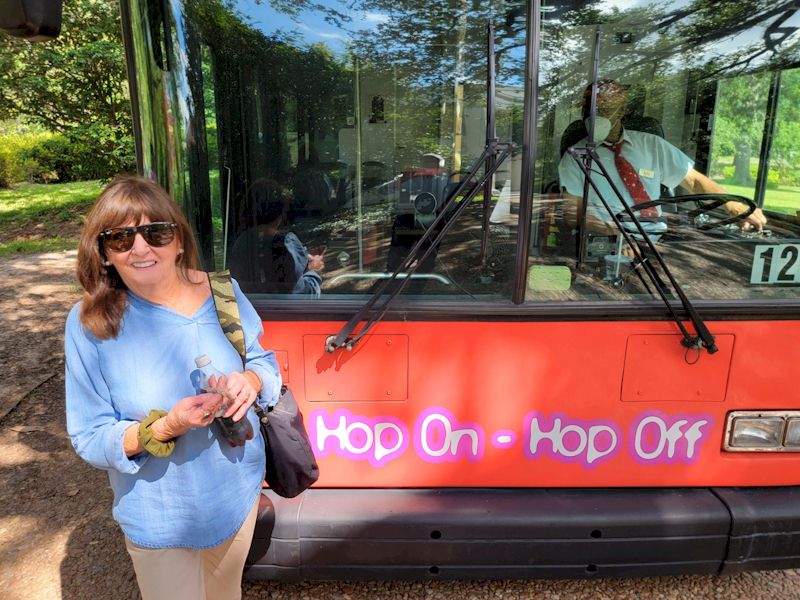
Sarah with the Hop On - Hop Off Bus
We also recommend a stop at the Visitor’s Center and the Hop On – Hop Off bus available there.  The bus tour is a great introduction to the city’s attractions and an excellent means of transportation between historic sites.

The best and worst times to visit Natchez are for the spring and fall “pilgrimages.”  These times are the best because more antebellum homes are open for tours and there are many special events.  These times are the worst because the city is crowded with other pilgrims.  However, for history and old house lovers, a visit to Natchez is worthwhile most any time.

Read the companion blog titled Antebellum Splendor.


Thursday, June 30, 2022

Antebellum Splendor in Natchez, Mississippi

Longwood Mansion

We visited Natchez, Mississippi, for its wealth of antebellum homes – many available to tour.  I was in Natchez perhaps 30 years ago.  For my heritage travel partner Sarah this was a new experience.  There’s more about out travel experience at Welcome to Natchez.

Before the Civil War, Natchez had more millionaires per capita than any other city in the United States.  Those millionaires displayed their wealth lavishly with their homes.  All that we visited are built of brick and cypress.  Cypress is resistant to both moisture and insect damage.  Freshly cut cypress is also less likely to warp than its the more readily available pine.  

Many of the most impressive homes are now owned by nonprofit organizations and are open to the public.  All the historic homes we visited on this trip (and those we hope to visit in the future) are National Historic Landmarks (NHLs). This designation shows the importance of a property to the heritage of the United States. According to the National Park Service, each represents an outstanding aspect of American history and culture.

Longwood

I did not tour Longwood (photo at top) on my earlier visit and was certainly on my bucket list for this trip.  It is the largest octagonal house in the United States and one of the largest homes in Natchez at 30,000 square feet.  Begun in late 1859, it is also unique because it has stood unfinished since 1861.

Longwood was built for Dr. Haller Nutt.  While he had a medical degree, Nutt was primarily a planter.  He and wife Julia had eleven children.  Eight lived to adulthood.  Julia had always wished to reside in Natchez rather than on one of their plantations, and Haller surprised her by purchasing the land on which Longwood sits in 1850.  The land included an old house which they used for a time.

Nutt hired Philadelphia architect Samuel Sloan to draw the plans for his mansion.  Wishing to avoid the Greek Revival style so prominent in Natchez, Sloan proposed a villa with a Moorish dome.  He was a proponent of the octagon shape because it provided 20 percent more interior space than the same length of walls built in a square.  It also created the opportunity for more balconies and exterior spaces.

Longwood Servant / Slave Quarters

The first construction was the large brick dormitory for the anticipated 32 servants / slaves that would eventually be needed.  The Nutt family temporarily occupied this building when the original old house was removed to make way for the new mansion.

Architect Sloan brought artisans from Philadelphia to build the main house.  However, with the outbreak of war in April 1861, those men returned to their homes in fear.  Nutt used local craftsmen and his own slaves to finish the basement as new temporary quarters.

Haller Nutt passed from pneumonia in 1864.  The family never regained its wealth after the war and the house remained uncompleted.  However, Haller and Julia’s descendants occupied the lower level for another century. 

Longwood Balcony
The Pilgrimage Garden Club has owned Longwood since 1970.  At that time, the roof and especially the gutters were in desperate need of repair.  Some inside timbers needed to be replaced due to water damage.  A supply of similar timbers was found in an old barn on the property, and wood salvaged from the barn itself was used to repair the Moorish cupola.

Perhaps one day the garden club will be able to restore Julia’s 15 acres of gardens including 10 acres of rose bushes.  The grounds are now completely overgrown making the approach and departure from the mansion far less than exciting.

Rosalie Mansion

Rosalie Mansion

One of the nation’s first Greek Revival mansions and the oldest in Natchez, Rosalie was built in 1823.  Of all the mansions we toured, it sits closest to the river on the edge of the high bluff providing a magnificent view of the river.  It was also the smallest of the mansions we saw at “only” 13,000 square feet.

View of the Mississippi

Fort Rosalie was built when the city was founded in 1716 and the neighboring house took its name. The site of the fort today is part of the Natchez National Historical Park.

Rosalie was the dream home of Pennsylvania cotton broker Peter Little and his wife Eliza. They lived in the home until 1857 but had no heirs.  The second owners, the Andrew Wilson family, redecorated including elaborate plasterwork, marble mantels, and gilt overmantels.  Many of the Wilson’s furnishings remain today.

During the war, Rosalie was used as Union headquarters, occupied by General U. S. Grant and others along with the Wilsons.  Wilson family members remained in the house in 1938 when it was sold to the present owners, the Mississippi Daughters of the American Revolution.  The Wilson heirs remained in the home until 1958 and gave daily tours.

Kitchen and Whistler Walk

Like so many older homes, Rosalie had a separate building for its kitchen and cook’s quarters to keep heat and the possible cooking fire away from the main house.  We never learn whether the covered “whistle walk” from the kitchen to the dining room was original to the home.

Bell from the U.S.S. Mississippi

The bell from the World War I U.S.S. Mississippi hangs in plain sight in the gardens at Rosalie. Interestingly, online research suggests the same bell is on display outside the Naval Shipyard Museum in Portsmouth, Virginia, and at the Mississippi Capitol in Jackson.


Stanton Hall

Stanton Hall

Cotton broker Frederick Stanton built the 40,000 square foot Stanton Hall in 1857.  The largest home in Natchez, Stanton called the home Belfast after his ancestral Ireland but lived there only nine months before succumbing to yellow fever.  The name change came in 1890 when the building became home to the Stanton College for Young Ladies.

Another of Natchez’s Greek Revival mansions, this one occupies an entire two-acre city block. The owners, the Pilgrimage Garden Club, has found creative ways to provide for maintenance of the home including year-round tours and adding a pool and restaurant to encourage club membership.

Because we were there on a Monday that was also the Juneteenth national holiday, the restaurant was open only to club members.  However, the staff at the gift shop suggested an interesting breakfast and lunch restaurant also on High Street called The Little Easy.  Quirky but good.

Stanton Hall’s most interesting feature is its triple parlor.  One third is enclosed by sliding doors while the larger portion is divided by a structural hanging arch to support the walls above.

Mr. Stanton certainly spared no expense in building the home sending its architect to Europe to obtain the finest accessories available.  That architect, Thomas Rose, wished to sign his name somewhere on his masterpiece, but Stanton would not allow it.  Not to be thwarted, the wrought iron fence surrounding the home is decorated with roses.

 Next Time

There’s a lot that we missed, partly because of timing and partly due to sweltering heat.  We hope to return to Natchez one day to see more mansions including the “suburban” homes below.

Monmouth

Monmouth
Set on 26 acres of gardens, the ca. 1818 Monmouth Mansion is privately-owned and operated as an Inn with the Restuarant 1818.  It is Natchez's only AAA Four Diamond Hotel. Tours are available at 10:00 and 2:00. 

Melrose

Melrose

Melrose is a 15,000 square foot Greek Revival mansion that is part of the 80-acre Natchez National Historical Park.  It was completed in 1848 for John T. McMurran, a lawyer and planter.  Because the house was always sold with its furnishings, it is said to be the most intact antebellum estate in the South.  Tours are available at 10:00, 11:00, 2:00, and 3:00.

Thursday, March 31, 2022

Small Town Big History in Washington, Georgia

While in Savannah, Sarah (my heritage travel partner) and I took the opportunity to visit Washington, Georgia.  The most direct driving route would take a little over three hours.  Instead, we traveled west to Dublin, Georgia, and then north through Sandersville to retrace the path (in reverse) of Jefferson Davis as he fled from Union forces at the close of the Civil War. This route took about four hours.

Washington, population just over 4,000, is the county seat of Wilkes County, Georgia. This small city is often called Washington-Wilkes to differentiate it from other places with the same name.  It is located equidistantly from Augusta and Athens, Georgia – less than an hour from each.

Fitzpatrick Hotel

One part of our attraction to Washington was its historic hotel – The Fitzpatrick.  First completed in 1898, the hotel stood empty from 1951 until 2004 when it reopened after a complete renovation.  The Fitzpatrick today reflects its Victorian origins with period furnishings and a color pallet of reds, golds, and greens.  Our stay in a second-floor suite overlooking the town square gave us all the modern conveniences including a newly installed elevator.

The Fitzpatrick is also home to Maddy’s Public House, open Thursday through Sunday.  Opened in 2019, Maddy’s has live music on Thursday and Saturday nights.  We found Maddy’s to be the best in town with selections ranging from sandwiches to Fish and Chips and Prime Rib.

Heard's Fort Marker
In Washington, history runs deep.  The revolutionary Battle of Kettle Creek took place about eight miles southwest of present-day Washington in 1779.  It was an important victory for the patriots who scattered a loyalist force and killed about 70 while losing only 32 of their own.  In 1780 and 1781, Heard’s Fort, a now desolate location about seven miles northeast of Washington, was the temporary capital of Georgia. 

But Washington is better known for its role at the beginning and the end of the Confederacy. Some would even say that one Washingtonian was indirectly responsible for Jefferson Davis being elected to the Confederate Presidency. 

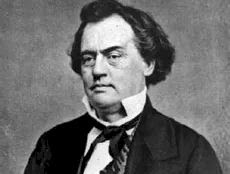
Robert Augustus Toombs
Robert Augustus Toombs, a wealthy planter and slaveholder, served in the United States Senate from 1853 to 1861.  On secession, he traveled to Montgomery, Alabama, to help craft the new nation. He was considered a likely candidate for President of the Confederacy.  Unfortunately, the night before the election, Toombs partied with the South Carolina delegation and became a little too "tight."  This reduced his stature with the delegates, resulting in Davis being elected as the provisional president.  The people of the Confederacy later elected Davis again.

Despite Toombs' failings and lack of diplomatic skills, Davis selected him to be the Confederacy’s first Secretary of State.  However, in frustration with President Davis, Toombs quickly resigned his cabinet position.  In July 1861 he was commissioned as a brigadier general.  After being wounded at Antietam, he resigned that commission in March 1863.  He later fled to Paris to avoid union arrest, returning to Georgia in 1866.

Robert Augustus Toombs House

The Toombs House, built in 1797 by Dr. Joel Abbott, is preserved as an historic site and is open for visitors.  Guided tours were not available at the time of our visit, but an excellent visitors' book led us through the house.  The are many displays on the basement level detailing the life and career of Robert Toombs and also the enslaved people who worked at the home.

Because the family occupied the home until the 1970s, the main and second floors contain many items that belonged to Toombs himself.  Interestingly, the main floor includes a room reserved for Alexander Stephens – Toombs’ best friend, vice president of the Confederacy, and later Georgia governor.  Though slight (less than 100 pounds) and frail (often using a wheelchair), Stephens was a political powerhouse. 

Wahington-Wilkes Historical Museum

Just to the east on Robert Toombs Avenue is Washington-Wilkes Historical Museum. The home was built ca. 1835 by Albert Gallatin Semmes. As a museum, it has an interesting collection of artifacts including Jefferson Davis' camp chest – left behind in Washington as he traveled further south to avoid capture. 

Wilkes County was fortunate not to be included in the battle plans of either the North or the South during the Civil War.  After General Sherman cut the South Carolina Railroad, Washington became a thoroughfare between the capital in Richmond and much of the South.  Avoiding larger cities and Union forces, it was also on the route used by Jefferson Davis and, proceeding ahead of him, his wife and family during their flight. 

Bank of the State of Georgia
Davis arrived on May 3, 1865.  While important guests typically stayed with General Toombs, he was out of town.  Thus, Davis stayed above the Bank of Georgia with bank cashier Dr. J. J. Robertson.  The bank was located at the north end of the square. 


Jefferson Davis Marker
The next morning, before his departure, Davis called the last cabinet meeting of the Confederacy at the bank.  It was where Davis made his last official act as president, effectively dissolving the Confederacy. 

While some locals tried to preserve the bank building, it was replaced by the present Wilkes County Courthouse in 1914.  In front of the courthouse is a marker commemorating Davis's time in Washington.

Tiffany Window

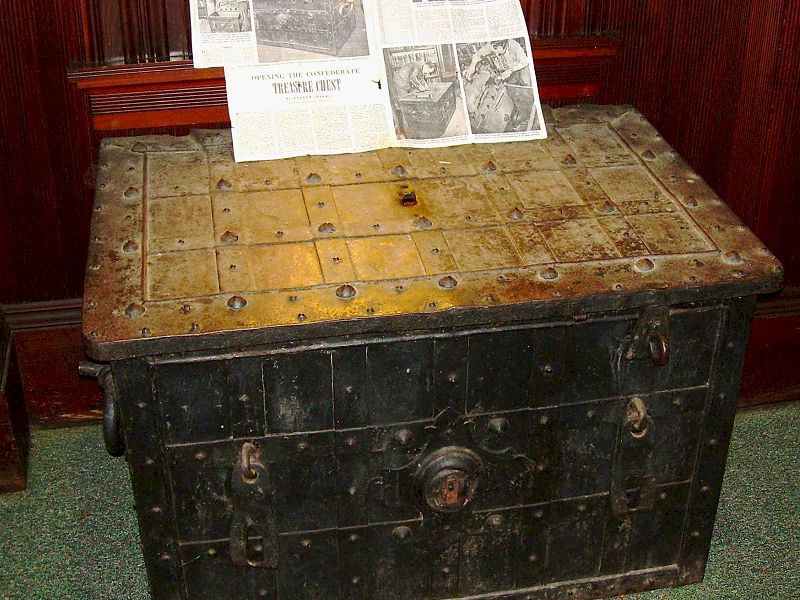
Among our last visits in Washington was the Mary Willis Library.  When it opened in 1889, it was the first free public library in the State of Georgia.  While built as a library, it more resembles a church with ornate Tiffany stained-glass windows. Included in its collection is a trunk 
left behind in Washington that once contained a part of the Confederate treasure.

Treasure Chest

No trip to Washington would be complete without viewing the scores of National Register historic homes on the city's many side streets.  Many are antebellum.  There are also five National Register historic districts with even more homes and properties to be seen.

Callaway Plantation House

We ran out of time and energy to do more than drive by the historic Callaway Plantation, again on the National Register.  In addition to the 1869 Greek Revival plantation house, other buildings have been moved to the site to create an open-air museum.  We plan to visit Callaway at some time in the future.

Sources:
Numerous web sources including Wikipedia and the City of Washington
The Long Surrender by Burke Davis (1985)
Flight Into Oblivion by A. J. Hanna (1938)
The History of Wilkes County, Georgia by Robert M. Willingham, Jr. (2002)

Monday, August 10, 2015

Millford Plantation

Millford, near Pinewood, South Carolina, is the second home that we have visited acquired and restored by Richard Jenrette and donated to the Classical American Homes Preservation Trust.  The first, in the spring of 2014, was Ayr Mount in Hillsborough, North Carolina.

Built around 1840, this Greek Revival mansion was built by the son of a South Carolina governor who later became governor himself.  While the exterior of the house is stunning, it is perhaps most famous for containing most of its original furnishings by Duncan Phyfe & Son. 

In addition to its furnishings, the double parlor was particularly interesting because it could be divided by closing a large set of mirrored folding doors.  In fact, there are many outstanding mirrors throughout the house.

At first, it struck me as odd that Millford had no connection to the nearby Santee River other than as a means to receive its furnishings from New York.   However, while labeled a plantation, Millford was actually a large country home rather than a working farm.  Water transportation was not needed to ship the produce from its fields.

This lack of water, my lack of interest in Phyfe, and its complete isolation left me thinking that I would not want to live at Millford – then or now.  Choosing between Mr. Jenrette’s properties we have visited, I much prefer Ayr Mount for its location and its more practical layout.

Wednesday, March 4, 2015

Stetson Mansion

Marjory and I toured the Stetson Mansion in Deland, Florida, on March 3, 2015.  This may have been our most delightful tour ever.  We particularly enjoyed comparing the features of this home with its near contemporary, our W. F. Patton house in Danville, Virginia.

A winter home for famous hat maker John B. Stetson, this 1886 home is a private residence rather than a public house museum.  The owners live there every day, maintaining the property and conducting tours with the assistance of only two docents.  Our docent, Debbie Pixley, obviously loved what she was doing, blending Stetson history with the amazing story of the home's renovation.

Stetson Mansion, west and south fronts
While it is not the largest or the most ideally situated, the Stetson is the oldest gilded-age mansion in Florida.  While only 2.3 acres now, it was at one time situated on 300 acres of orange groves, pineapple fields, and sugar cane.

Perhaps the most outstanding feature of the home is its floors.  While many Victorian houses have floors with ornate borders, this house has nothing but borders.  Note the fine tessellation on the floor of the music room below.

Front / entry porch, parlor, and music room
Without a doubt, a visit to the Stetson is well worth the time and expense.  Reservations are required, which can only be made at their web site online.

More of Deland

After our visit to the Stetson Mansion in Deland, Florida, we adjourned for lunch at the Brickhouse Grill in the downtown shopping area.  Don't bother.  But on our drive away from the Brickhouse, we stumbled upon the Athens Theatre.  I couldn't resist taking a photo of this 1922 beauty which began its life showing silent films and hosting vaudeville acts.  It was restored in 1994.


But on to our next destination, the Deland House Museum.  Note that this is not the home of Mr. Deland, but rather a house museum in the city that bears his name.  While this house is of the same vintage as the Stetson Mansion, 1886, the two houses are of different worlds. 


Operated by the West Volusia Historical Society and staffed by volunteer docents, this house illustrated the life of the middle class in turn-of-the-century Florida with period-appropriate furnishings and artifacts.  Perhaps its best feature are the numerous photographs of the city as it developed. 

The historical society has a very nice library in an adjoining building called the Conrad Education and Resource Center.  It also operates the old Deland hospital, which we hope to visit in the future.
  

Monday, August 11, 2014

Red Hill Plantation

The Independence Day weekend seemed an appropriate time to visit Red Hill Plantation, the Patrick Henry National Memorial.  Located near Brookneal, Virginia, Henry bought Red Hill on his retirement in 1794 and continued here until his death in 1799.

Unlike other historic properties we have visited, Red Hill is not particularly grand and is partly a reconstruction.  While Henry’s law offices and some other outbuildings are original, the plantation house (below) was reproduced in 1954.


The beauty of Red Hill is its idyllic setting.  Located on the Staunton River, it was once a 520-acre tobacco plantation.  Flatboats called bateaux carried the crop downstream.

The Red Hill Visitor’s Center includes a museum with the largest collection of Henry memorabilia anywhere.  The centerpiece is Peter Rothermel's famous painting Patrick Henry before the Virginia House of Burgesses, depicting his "If this be treason, make the most of it" speech against the Stamp Act in 1765.

We were especially interested in the Henry Family Tree.  Henry’s first wife, Sarah Shelton (1738-1775) is Marjory’s third cousin six times removed.

For a nice drive in the country and a pleasant setting, Red Hill can’t be beat.

Sunday, April 27, 2014

Ayr Mount

While we are more likely to visit homes built after the Civil War, our last two visits have been to earlier homes from the Georgian / Federal period.  But our lack of attention to Ayr Mount, so close to our home in the piedmont of Virginia, is more due to the difficulty in finding house museums to tour.

Ayr Mount was completed in 1815 in Hillsborough, North Carolina.  William Kirkland named the house in honor of his birthplace, Ayr, Scotland.

Due to its Federal style, Ayr Mount looks simple and austere on the outside. It is one of the first homes built of brick in the piedmont.


Conversely, the interior is quite grand.  It has elaborate woodwork and plasterwork with a ceiling height of 14 feet on the main floor.  One particular style of cornice caught my eye because I had never seen it before.

While a few of the furnishings belonged to the Kirkland family, most are period pieces from the collection of Richard Jenrette.  Ayr Mount was first intended to be a retirement home for Jenrette, a Raleigh native.  But with the acquisition and restoration of other fine homes, he has established a preservation trust to open them to the public.  We can’t wait to visit others.
 

Friday, April 4, 2014

Savannah’s Isaiah Davenport House

In late March, Marjory and I had the opportunity to Savannah, Georgia.  The older part of Savannah is a compact, walkable city built around numerous public squares.  Among our stops there was the Isaiah Davenport House Museum.

Originally trained as a carpenter in Rhode Island, Davenport relocated to Savannah in 107 or 1808.  In addition to being a carpenter and builder, he served as one of Savannah’s fire masters, a constable, a city alderman, and a member of the board of health.

He built his own home in 1820.  It is one of the earlier brick structures in the city located with a fine view of Columbia Square, the squares being the most desirable locations.  The house has been immaculately restored to its decoration and furnishings from the 1920s.  Of particular note are the wallpapers, faux finishes, and plaster cornices.


The Davenport House was the genesis for the Historic Savannah Foundation (HSF), which owns and operates the house today.  However, this was just the beginning for HSF, which has stimulated the preservation of many fine Savannah houses and the repurposing of many commercial properties.  As a result, present-day old Savannah oozes history from every pore.

Friday, March 14, 2014

Harry P. Leu Gardens

The Leu Gardens were bequeathed to the City of Orlando in 1961.  In addition to 50 acres of gardens, the site includes the Leu House Museum.  Marjory and I visited during February, 2014.

Harry P. Leu owned a successful industrial supply company.  In 1936, he purchased the property fronting Lake Rowena.  The house on the property was first constructed in the latter part of the 1800s, with Leu later becoming the fourth owner.

Harry and his wife Mary Jane traveled extensively and brought back plants, cuttings, and seeds from all over the world.  This is evidenced by the many tropical and sub-tropical gardens across the acreage.  There are pathways, gazebos, fountains, and rain shelters throughout.


The Leu Garden is particularly well known for its camellias, some of which were in bloom.  The trumpet trees were also flowering.  Perhaps because we were there in mid-winter, the garden beds did not seem particularly well tended.

The house was expanded several times over the years, but the main rooms has been restored to their turn of the century appearance.  Other areas, including the kitchen and bathrooms, have an Art-Deco motif.  While the house is not spectacular in any way, its docent-led tour provides an interesting and accurate glimpse of living in old Florida.  Well worth the 25 minutes.


Overall, our visit to the Harry P. Leu Gardens was a pleasant one – a relaxing morning but with tired legs at the end.