Showing posts with label Civil War Stories. Show all posts

Thursday, December 29, 2022

Treasure in Chennault, Georgia

While visiting Washington, Georgia, Sarah (my heritage travel partner) and I traveled northeast to the area known as Chennault.  Our purpose was to trace the route used by Jefferson Davis as he fled from Virginia.  Little did we know that Chennault had significance beyond Davis’s passing.

Chennault takes its name from the family who lived and planted there.  A plantation house at the corner of Elberton Road (GA 79) and Graball Road (GA 44) once belonged to Dionysius “Nish” Chennault, a 300-pound Methodist minister who was also a planter. 

While the house has had wings added to the side and rear over the years, it is listed on the National Register for its architectural as well as social significance.  Built shortly after 1850, it is a five-bay, two-story, late Greek Revival frame weatherboard house with high pitched gabled roof, a full width two-story portico and two central chimneys, serving eight interior fireplaces.  The photo below shows the house in 1976 – the year of its nomination.

Chennault Plantation House c. 1976

Part of its architectural significance is its relationship with three other houses – all within six miles.  The houses are of remarkably similar style suggesting a single master builder, and all were nominated to the National Register.  Part of its social significance is from Jefferson Davis and other Confederate officials passing nearby on the morning of May 3, 1865.

The Chennault property also has the unique significance of witnessing two raids on the Confederate treasure.  The treasure had two parts – specie and jewels belonging to the Confederate government and precious metals belonging to the Bank of Richmond. 

The wagons carrying the treasure – some called it a treasure train – traveled to Georgia with and behind the fleeing Davis party.  On May 4, 1865, at Chennault, unpaid Confederate troops demanded immediate payment from the Secretary of War General Breckenridge.  Breckenridge acquiesced with later ratification by President Davis.  The remainder of the Confederate treasury along with the precious metals belonging to the Bank of Richmond continued on to be held at the Bank of Georgia in Washington.  

Twenty days later, on the night of May 24, 1865, Union troops were not-so-secretly returning the Bank of Richmond metals to the north. They camped at Chennault for the night. Confederate raiders, some say Tennesseans, attacked as night fell.  Much of the bank’s gold and silver was carried off, though bank employees recovered about $40,000 that had been dropped in the dark the next day.

Local legends say the name of route GA 44 near Chennault is a result of this raid.  Graball Road was where you would “grab all the treasure you can.”

Some say parts of both treasures are still missing.  Some is said to be buried at Danville, Virginia, some buried at Chennault, and some moved to other locations.  Entire books have been written and reality TV episodes produced on the whereabouts of the lost treasure.  One TV mini-series even searched the bottom of Lake Michigan.

The pastoral Chennault house today belies its exciting history.

Chennault House 2022
Sources:
Carroll, J. Frank; Confederate Treasure in Danville (1996)
Davis, Burke; The Long Surrender (1985)
Williams, Vinnie; Legends surround old homes named to national register;
       Augusta Chronicle-Herald (September 5, 1976)
Willingham, Robert M. Jr.; The History of Wilkes County, Georgia (2002)


Monday, November 7, 2022

Jefferson Davis Came to Danville Twice

Most Danvillians know the story of the Confederate government evacuating from Richmond to Danville.  President Jefferson Davis, his cabinet, and many other officials arrived in Danville by the Richmond and Danville Railroad on Monday afternoon, April 3, 1865.  Here they received a warm welcome from the mayor and the townspeople. 

Confederate President Jefferson Davis

President Davis became a guest at the stately home of Major William T. Sutherlin on the outskirts of town.  Other cabinet members also became guests at other fine Danville homes.  And space was assigned for the necessary government offices.  It was hoped that the government would remain in Danville for a time.

However, the situation changed quickly.  Less than six days later, about noon on Sunday, April 9, General Robert E. Lee surrendered the Army of Northern Virginia at Appomattox. Word of the surrender reached Danville the next day.  It was feared that Union troops could arrive at any time, so the decision was made to move further south.  President Jefferson Davis and the Confederate government left Danville for Greensboro on a Piedmont Railroad train at 11 p.m. on Monday, April 10, 1865.

The Confederate First Lady, Varina Howell Davis, passed through Danville a few days ahead of the President’s arrival. For her safety, he had sent her ahead to Charlotte where he had rented a home for the family.  Varina traveled with their children (Maggie age 8 or 9, Jefferson Jr. age 7, Willie age 4, and Varina Anne a.k.a. Pie Cake or Winnie age 9 months), an informally adopted black son four- to six-year-old Jim Limber, Varina’s sister Maggie Howell, two servants, and the President’s trusted private secretary Burton Harrison as escort.  The party also included the two daughters of Treasury Secretary George Trenholm and Midshipman James Morris Morgan.  In addition to his duty as a guard for the party, Morgan was also the fiancé of Betty Trenholm.

Davis Children -- Jefferson Jr., Maggie, Varina Anne, and Willie with Jim Limber


Historians disagree on when the party left Richmond – either March 29 or March 30, 1865.  Due to the poor condition of the Richmond and Danville Railroad, they did not arrive in Danville the next day.  While Danville extended its usual hospitality and offered for the party to stay, they continued on, arriving in Charlotte on Tuesday, April 4.

Skipping ahead many years, the Davis family took up residence in Biloxi, Mississippi.  While traveling, Jefferson Davis died in nearby New Orleans on December 6, 1889, at the age of 81.  A grand funeral was held drawing larger crowds than even for Carnival.  Jefferson Davis was temporarily interred in the tomb of the Army of Northern Virginia at Metairie Cemetery.  


Soon after, Varina moved to New York City to be near to publishers of her husband’s memoirs and because the hot climate of the Mississippi coast was bad for her health. She likely passed through Danville when she moved and perhaps on other occasions.  Danville was, after all, a railroad hub at that time and is still on the line to New Orleans.

It was not until July 1891 that Varina Davis decided that her husband’s final resting place should be Hollywood Cemetery in Richmond.  She visited Richmond later that year to select a specific site.  It was also decided that the reburial would take place on May 30, 1893, though this was later changed to May 31.  Of course, Jefferson Davis’s body would be transported from New Orleans to Richmond by rail.

At the request of the state governments, the body would lie in state at their capitals – Montgomery, Atlanta, and Raleigh – and then be carried north through Keysville, Virginia, to Richmond.  However, the people of Danville pleaded urgently to have a stop in their town – the Confederacy’s last capitol.  This was agreed once officials of the Richmond and Danville Railroad assured the organizers that this would not affect the schedule in Richmond. 

Thus, the funeral train backtracked to Durham and Greensboro, and then north to Danville.  It arrived at 9:00 p.m. on May 30, 1893.  As it rolled into the station, a choir sang “Nearer, My God, to Thee.”  About 6,000 people were assembled and so crowded the train that soldiers were forced to press them back with their rifles.  Few ever saw the casket in the funeral car. 

Every church bell in Danville rang on the second visit of Jefferson Davis as the funeral train departed for Richmond.


Sources:
Ballard Michael; A Long Shadow (1985)
Clark, James C.; Lat Train South (1984)
Collins, Donald E.; The Death and Resurrection of Jefferson Davis (2005)
Davis, Burke; The Long Surrender (1985)
Johnson, Clint; Pursuit (2008)
Swanson, James; Bloody Crimes (2010)

Thursday, July 14, 2022

Welcome to Natchez, Mississippi

Cruise riverboat docked Under the Hill

Natchez proper sits on bluff far above the Mississippi River.  However, Natchez was founded in 1716 in an area called “Natchez-under-the-Hill” at river level.  This area was once the rowdiest port on the river – now sometimes called “Natchez improper.”  Like the steamboats of the past, riverboat cruises now dock under the hill.

At the time of the American revolution, Natchez was recognized as Britain's fourteenth colony.  Much of Natchez was pro-Tory and paid little attention to the conflict occurring on the eastern seaboard.  And it was so remote and inaccessible that England never sent troops to the area.

The lowlands along the river in both Mississippi and Louisiana were prime country for growing large crops of cotton and sugarcane using slave labor.  Natchez was the main point of export.  Before the Civil War, wealthy planters built town homes there in addition to or instead of plantation homes.  In the decades preceding the Civil War, Natchez had the most millionaires per capita of any city in the United States.  Many of their homes – often mansions – remain today because Natchez surrendered to Union forces without a fight.  The homes are now part of Natchez identity and make it a tourist destination. 

Shackles at Forks in the Road

Natchez was the second largest slave trading center in the United States.  Slaves were placed on display at a place called “Forks of the Road.”  Shackles that bound them remind visitors of this terrible time.  
Forks of the Road is recognized by The United Nations Educational, Scientific, and Cultural Organization (UNESCO) as a world heritage site.

Jefferson College
Other Confederate connections include the military boarding school attended by Jefferson Davis as a boy.  Davis attended Jefferson College, named in honor of President Thomas Jefferson, in 1818 at the age of ten before transferring to a school in Kentucky.

The Briars
Davis also took a Natchez native, Varina Howell, as his second wife.  They were married at the Howell’s residence, The Briars, in 1845.  (The Briars was inaccessible and for sale at the time of our visit.)  It is said that Jefferson Davis once owned the Governor Holmes House on Wall Street, now a bed and breakfast.

Dixon Loft above

Adult beverage on the Dixon balcony
For our short-term stay, Sarah (my heritage travel partner) and I were fortunate to book the Dixon Lofts. Newly refurbished, the 3,000 square foot Dixon features 13-foot ceilings, a fully equipped galley, and a balcony with wrought iron overlooking Main Street.  Three large on-suite bedrooms and a laundry provided every comfort.  We greatly enjoyed the immense sitting / dining / living area.  The balcony was well used for both morning coffee and evening libations.  These 160-year-old quarters just couldn’t have been better.  We visited over Father’s Day and the Juneteenth holiday.  


River view from the Magnolia Grill patio

Another view from the Magnolia Grill
There are plenty of dining choices in Natchez.  The best for us was the Magnolia Grill located under the hill.  The Magnolia has an enclosed patio with great views of the river.  This is complemented by their excellent menu.  For appetizers we enjoyed the fried green tomatoes and the crabmeat stuffed mushrooms.  I had the Silver Street Pasta that I thought was the best past dish ever.  Sarah enjoyed the fried shrimp.

The Castle at Dunleith
Another great dining choice is The Castle.  This building was originally the carriage house for the antebellum Dunleith house – now a historic inn.  Sunday brunch options on Father’s Day included a smothered pork chop that got rave reviews. 

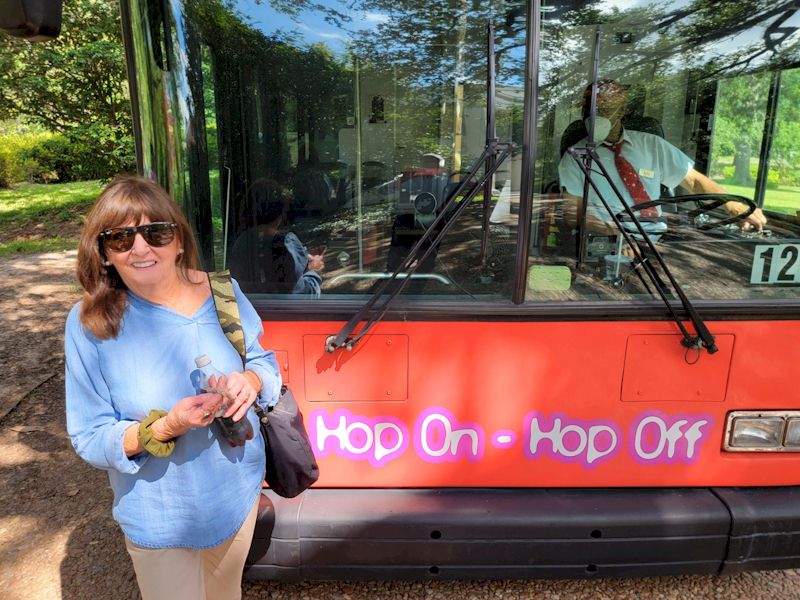
Sarah with the Hop On - Hop Off Bus
We also recommend a stop at the Visitor’s Center and the Hop On – Hop Off bus available there.  The bus tour is a great introduction to the city’s attractions and an excellent means of transportation between historic sites.

The best and worst times to visit Natchez are for the spring and fall “pilgrimages.”  These times are the best because more antebellum homes are open for tours and there are many special events.  These times are the worst because the city is crowded with other pilgrims.  However, for history and old house lovers, a visit to Natchez is worthwhile most any time.

Read the companion blog titled Antebellum Splendor.


Thursday, March 31, 2022

Small Town Big History in Washington, Georgia

While in Savannah, Sarah (my heritage travel partner) and I took the opportunity to visit Washington, Georgia.  The most direct driving route would take a little over three hours.  Instead, we traveled west to Dublin, Georgia, and then north through Sandersville to retrace the path (in reverse) of Jefferson Davis as he fled from Union forces at the close of the Civil War. This route took about four hours.

Washington, population just over 4,000, is the county seat of Wilkes County, Georgia. This small city is often called Washington-Wilkes to differentiate it from other places with the same name.  It is located equidistantly from Augusta and Athens, Georgia – less than an hour from each.

Fitzpatrick Hotel

One part of our attraction to Washington was its historic hotel – The Fitzpatrick.  First completed in 1898, the hotel stood empty from 1951 until 2004 when it reopened after a complete renovation.  The Fitzpatrick today reflects its Victorian origins with period furnishings and a color pallet of reds, golds, and greens.  Our stay in a second-floor suite overlooking the town square gave us all the modern conveniences including a newly installed elevator.

The Fitzpatrick is also home to Maddy’s Public House, open Thursday through Sunday.  Opened in 2019, Maddy’s has live music on Thursday and Saturday nights.  We found Maddy’s to be the best in town with selections ranging from sandwiches to Fish and Chips and Prime Rib.

Heard's Fort Marker
In Washington, history runs deep.  The revolutionary Battle of Kettle Creek took place about eight miles southwest of present-day Washington in 1779.  It was an important victory for the patriots who scattered a loyalist force and killed about 70 while losing only 32 of their own.  In 1780 and 1781, Heard’s Fort, a now desolate location about seven miles northeast of Washington, was the temporary capital of Georgia. 

But Washington is better known for its role at the beginning and the end of the Confederacy. Some would even say that one Washingtonian was indirectly responsible for Jefferson Davis being elected to the Confederate Presidency. 

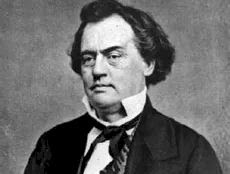
Robert Augustus Toombs
Robert Augustus Toombs, a wealthy planter and slaveholder, served in the United States Senate from 1853 to 1861.  On secession, he traveled to Montgomery, Alabama, to help craft the new nation. He was considered a likely candidate for President of the Confederacy.  Unfortunately, the night before the election, Toombs partied with the South Carolina delegation and became a little too "tight."  This reduced his stature with the delegates, resulting in Davis being elected as the provisional president.  The people of the Confederacy later elected Davis again.

Despite Toombs' failings and lack of diplomatic skills, Davis selected him to be the Confederacy’s first Secretary of State.  However, in frustration with President Davis, Toombs quickly resigned his cabinet position.  In July 1861 he was commissioned as a brigadier general.  After being wounded at Antietam, he resigned that commission in March 1863.  He later fled to Paris to avoid union arrest, returning to Georgia in 1866.

Robert Augustus Toombs House

The Toombs House, built in 1797 by Dr. Joel Abbott, is preserved as an historic site and is open for visitors.  Guided tours were not available at the time of our visit, but an excellent visitors' book led us through the house.  The are many displays on the basement level detailing the life and career of Robert Toombs and also the enslaved people who worked at the home.

Because the family occupied the home until the 1970s, the main and second floors contain many items that belonged to Toombs himself.  Interestingly, the main floor includes a room reserved for Alexander Stephens – Toombs’ best friend, vice president of the Confederacy, and later Georgia governor.  Though slight (less than 100 pounds) and frail (often using a wheelchair), Stephens was a political powerhouse. 

Wahington-Wilkes Historical Museum

Just to the east on Robert Toombs Avenue is Washington-Wilkes Historical Museum. The home was built ca. 1835 by Albert Gallatin Semmes. As a museum, it has an interesting collection of artifacts including Jefferson Davis' camp chest – left behind in Washington as he traveled further south to avoid capture. 

Wilkes County was fortunate not to be included in the battle plans of either the North or the South during the Civil War.  After General Sherman cut the South Carolina Railroad, Washington became a thoroughfare between the capital in Richmond and much of the South.  Avoiding larger cities and Union forces, it was also on the route used by Jefferson Davis and, proceeding ahead of him, his wife and family during their flight. 

Bank of the State of Georgia
Davis arrived on May 3, 1865.  While important guests typically stayed with General Toombs, he was out of town.  Thus, Davis stayed above the Bank of Georgia with bank cashier Dr. J. J. Robertson.  The bank was located at the north end of the square. 


Jefferson Davis Marker
The next morning, before his departure, Davis called the last cabinet meeting of the Confederacy at the bank.  It was where Davis made his last official act as president, effectively dissolving the Confederacy. 

While some locals tried to preserve the bank building, it was replaced by the present Wilkes County Courthouse in 1914.  In front of the courthouse is a marker commemorating Davis's time in Washington.

Tiffany Window

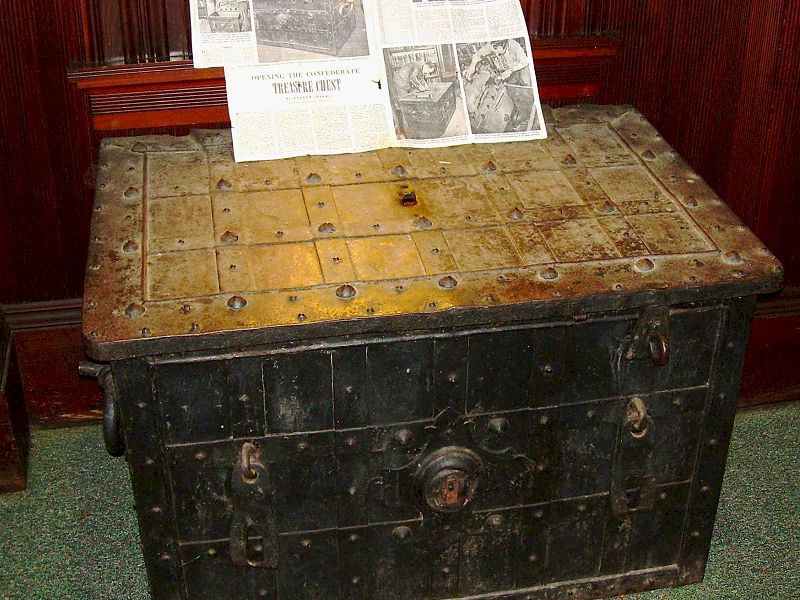
Among our last visits in Washington was the Mary Willis Library.  When it opened in 1889, it was the first free public library in the State of Georgia.  While built as a library, it more resembles a church with ornate Tiffany stained-glass windows. Included in its collection is a trunk 
left behind in Washington that once contained a part of the Confederate treasure.

Treasure Chest

No trip to Washington would be complete without viewing the scores of National Register historic homes on the city's many side streets.  Many are antebellum.  There are also five National Register historic districts with even more homes and properties to be seen.

Callaway Plantation House

We ran out of time and energy to do more than drive by the historic Callaway Plantation, again on the National Register.  In addition to the 1869 Greek Revival plantation house, other buildings have been moved to the site to create an open-air museum.  We plan to visit Callaway at some time in the future.

Sources:
Numerous web sources including Wikipedia and the City of Washington
The Long Surrender by Burke Davis (1985)
Flight Into Oblivion by A. J. Hanna (1938)
The History of Wilkes County, Georgia by Robert M. Willingham, Jr. (2002)

Thursday, December 25, 2014

Reeds, Colemans, and Civil War Marriages

An earlier post (see Paul’s Civil War Ancestors) includes Isaac Reed (1833-1863) and his wife Mary Jane Coleman (1839-1902), Paul’s great great grandparents. 

On August 4, 1862, President Lincoln called for another 300,000 men.  New Jersey was committed to 10,478 men.  New Jersey’s governor, Charles Smith Olden, threatened a draft if the quota was not met.  As a result, Isaac Reed and several of his cousins mustered to the 23rd Regiment of the New Jersey Infantry (also known as the Yahoos) on 13 Sep 1862 for a period of 90 days.  Isaac was a bit older than many soldiers – 29 at the time of his enlistment.  He died of typhoid fever during his service on 2 Jan 1863.  The widow Mary Jane remarried about nine months later to Henry Parker.

Isaac’s younger brother Joseph F Reed (1841-1865) mustered to the 3rd New Jersey Calvary, also known as the Butterflies, on 23 Aug 1864, perhaps to avenge his brother’s passing.  Joseph was married to Elizabeth Coleman (1843-1910), the younger sister of his brother’s wife Mary Jane Coleman.  Joseph too died of typhoid fever, he in the hospital at Harper’s Ferry on 20 Mar 1865.  Less than two months later, and about eight and one half months after his enlistment, Joseph’s wife gave birth to their son Joseph A Reed on 9 May 1865.

At the time of the Civil War, most women (and particularly younger women with young children) were unable to support themselves even if they had some land.  Thus, remarriage was often their only option for survival.  Like her sister, Elizabeth Coleman Reed married again quickly on 4 Jul 1865 – less than two months after her son Joseph was born.  Marriage records show the name of her new husband as Tull Workman, though he is listed in the 1870 census as Sarbert Workman.  The Workmans had two children – Anna in 1867 and Lizzie in 1870.  Mr. Workman’s whereabouts after 1870 are unknown.

By the 1880s, Elizabeth Coleman Reed Workman married a third time to George Donovan in the State of Delaware.  Elizabeth had two children with George – Andrew in 1883 and James in 1885.  By 1900, the Donovan family was living in Kansas.

In the effects of Andrew Donovan’s grandson Kenneth Mercer (1946-2007) there was a photo labeled Mary Jane Parker.  While she knew nothing of the many remarriages of the Coleman sisters, Kenneth’s widow Rhonda attached this photo to her private online tree at Ancestry.com. 

It is through her courtesy that the photo at right appears – Paul’s great great grandmother Mary JANE Coleman Reed Parker (1839-1902).  Thank you, Rhonda, for the only photo of a great-great grandparent in Paul’s tree.
 

Wednesday, February 12, 2014

Civil War Pensions

During the Civil War, soldiers who became totally disabled received a pension of $8 per month.  For soldiers who died, their widows could collect that $8 per month plus $2 for each of the soldier’s children under age 16.  At first, the pensions for widows terminated when the widow remarried though the children were still compensated.  Later, a widow who remarried could still receive the $8 per month, but only until her children were grown.  Payouts were made twice each year by a government paymaster.

Not surprisingly, there were problems with the pension system.  Many people were illiterate at the time, making the application process cumbersome.  The paymasters operated only in larger cities, requiring travel or the use of a proxy (who usually charged a fee).  For widows in particular, there may have been no official record of marriages or the birth of children, requiring many sworn affidavits to provide the required proof. 

With no enforcement mechanism, widows did not always report new marriages or chose to live “adulterously” to keep their pensions intact.  As a result, a law as passed in 1882 requiring pension recipients to be “of good character.”

In an earlier post, I discussed two of my great grandfathers who did not return from the Civil War.  John George Molz was killed during the Battle of Wilderness in 1864 while Isaac Reed succumbed to typhoid fever near Fredericksburg in 1863.  The families of both of these Union soldiers benefited from military pensions, but not without some difficulty.  Their pension case files, now online at Fold3, tell interesting stories.

Sophia (Gampper) Molz (at right in later years) promptly applied for and received a widow’s pension of $8 plus $2 for each of her four children (Ernstine, John George Jr, Carolina, and Susanna) in Bridesburg, Philadelphia.  While the pension for her children continued, Sophia’s reported her marriage to Jacob Yoos in 1865 and her stipend was terminated.  When Yoos became insane, she left him and lived with her sister in New York.  Five years later, and after serving as his housekeeper, Sophia married Joseph Meier, another Civil War veteran and a widower with four children.

After a change in the pension law in 1901 and after Meier’s death, Sophia could apply to have her pension from John Molz reinstated.  This request was denied because of her failure to divorce Yoos before marring Meier.  Sophia requested several rehearings claiming variously that she thought Yoos was dead when she married Meier, and later that Yoos’ actual death legitimized the union with Meier.  Again, her claims were denied.

While the pension examiner described her as “uneducated,” she was not to be cheated of the pension she thought she deserved.  Sophia applied again as the widow of Joseph Meier.  This too was denied on the basis that her marriage to Meier was bigamous and therefore invalid.  Sophia’s pension-related documents total 294 pages and includes copies of many family documents as well as depositions of her children.

Sophia continued to live in Bridesburg in the house that she and Joseph Meier built until her passing in 1920.  She and Joseph rest in the nearby Bridesburg Presbyterian grounds.

Mary Jane (Coleman) Reed (known as Jane) also requested a pension for herself and her three children with Isaac – Richard, Reuben, and Sarah Jane – in March 1863, less than two months after Isaac’s death.  However, this claim was abandoned because of Jane’s marriage to Henry Parker in September 1863. 

With the change in the law allowing benefits for widows with children even if they had remarried, Jane renewed her request in early 1869.  Perhaps because she was illiterate, Jane began by appointing Thomas S. Miller of Batsto as the guardian of her children.  Miller then applied for and collected the pension benefits retroactive to September 1863.  The first payment to Miller in May 1869 was a huge sum at the time – $683.25.  Through 1870, Miller was paid a total of $935.25 for the benefit of the children.

In October 1870 there must have been a falling-out been Jane Reed Parker and Thomas Miller.  Jane dictated a letter to the pension agency claiming that Miller had not made any payments in over a year and had spent the pension moneys to buy a horse and for drink.  She asked that he be removed as guardian.  The next month, Miller countered that he had made payments to various parties for the benefit of the children.  Among others, he paid Josiah Ford, Jane’s uncle, $100 for board and clothing.  This suggests that the children did not always live with their mother Jane and stepfather Henry Parker. 

Miller offered that he did not pay directly to Jane and Henry Parker because they would have spent the money for rum.  This disagreement resulted in an accounting by Miller that was accepted by the Burlington County Orphan Court as accurate.  It appears that pension benefits continued to be paid through Miller until 1877 when the youngest child, Sarah Jane, reached the age of 16.

Interestingly, the only known birth record for Sarah Jane Reed (at right in 1909), my father’s maternal grandmother, is the affidavit from midwife Elizabeth Moore contained in the pension case file.  While her brothers’ births were officially reported, Sarah Jane was somehow omitted. 

By 1900, Jane and Henry Parker had moved to Brookville in Ocean Township, Ocean County.  Jane passed there in 1902 followed by Henry in 1910.  They rest in the Reevestown Cemetery in what is now Barnegat, New Jersey.
 

Friday, January 31, 2014

Paul's Civil War Ancestors

Each of us has eight great-great-grandfathers.  Of my eight, I know the names of six.  Three of those resided in the United States at the time of the Civil War.  One, John Dotts, was born in 1802, and was thus was too old to have served.  The remaining two, John George Molz Sr. of New York City and Isaac Reed from the South Jersey Pine Barrens enlisted.  Both were hospitalized during their service (for every three soldiers who died in battle, five more passed from disease), and both are likely interred in the Fredericksburg (Virginia) National Cemetery.

John Molz arrived from Baden-Württemberg as early as 1850 but certainly by 1854.  In July of that year, at the age of approximately 22, he married Sophia Catharina Gampper at the Evangelical Lutheran Church at 108 West 24th Street in New York City (now the site of a Hampton Inn). 

John worked as a tailor, and three children were born in short order – Ernstine Christine “Deana” in 1856, John George Jr. (my mother’s grandfather) in 1858, and Carolina in 1860.  The family lived variously in New York and Philadelphia.

Change came on the 11th of September, 1861, when John enlisted in Company E, 45th Regiment, New York Volunteer Infantry at the age of 29.  This regiment was also known as the 5th German Rifles and was composed almost entirely of German immigrants.  Military records say John was a small man – 5 feet 5 inches in height with a dark complexion, blue eyes, and light hair.  We don’t know whether he was motivated by the Union’s cause, or perhaps his young family needed a soldier’s salary plus any enlistment bonus being offered.

While the records are sketchy, the Muster Rolls from 28 October 1861 and 1 January 1862 show him as neither present nor absent.  On 8 May 1862 (from the Muster Roll for March and April), he was present.  However, the Muster Roll for May and June lists him as absent – sick in the hospital in Winchester, Virginia.  On 24 June 1862, the records list John as having deserted at Mount Jackson, Virginia. 

Desertion was not uncommon during the Civil War.  There was no process for taking leave, and John had been ill.  Because his fourth child, Susanna, was born in June 1863, John must have returned to his family.

Nearly a year and one half after deserting, perhaps upon his full recovery, John enrolled in Company K, 98th Regiment of the Pennsylvania Volunteers as a veteran on 23 Dec. 1863.  He enlisted in the field at Brandy Station, Virginia.  There may have been a sign-up bonus for re-enlistment.

About four months later on the 5th of May, 1864, John George Molz was killed in the Overland Campaign in the Battle of the Wilderness in Virginia – just 16 miles south from his point of re-enlistment.  After the war, the military attempted to remove bodies from the battlefield to the Fredericksburg National Cemetery, though John’s earthly remains may lie in the dense underbrush at Wilderness.


John’s widow, Sophia (Gampper) Molz, married twice more and had three more children.  She received a pension for herself until she remarried and for her children with John George Molz until they had grown.  Sophia passed in 1920 and is interred in the Presbyterian Grounds in Bridesburg, Philadelphia.

Isaac Reed was 17 years old at the time of the 1850 Census, meaning he was born between September 1832 and September 1833.  At that time, he was living in the home of his parents, Eden Reed and Rachael Ford in Burlington County, New Jersey.  Some of Isaac’s ancestors were on this continent before the Revolutionary War and were among the first to populate the wilds of New Jersey.

Isaac married Mary Jane Coleman in Washington Township, Burlington County on the first of March 1855.  Mary Jane was born 15 Oct 1839, being 15 years old at the time of her marriage.    Their first child, Richard Reed, was born in August 1855, just five months later.  A second son, Reuben, was born in April 1858.  Their daughter Sarah Jane (my father’s grandmother) was the last.  the records are unclear on her birth date – October 1860 or November 1861.

Isaac Reed joined the 23rd Regiment of the New Jersey Infantry on 13 Sep 1862.  Many of his Reed cousins – Alfred, Benjamin, Daniel, Eden, John, and Joseph – also enlisted on that day in Beverly, New Jersey, for a term of nine months.  Nicknamed the “Yahoos,” the 23rd’s first engagement was the Battle of Fredericksburg from 11 to 15 Dec 1862.  However, it is not known whether Isaac fought in that battle.  He may have already been suffering with the Typhoid Fever from which he passed on 2 Jan 1863. 

Isaac was buried at the White Oak Church in Falmouth, Virginia.  The church served as a Union hospital (see map above).  The sign above its door in the photo below reads "United States Christian Commission."  According to military records, all remains at White Oak Church were moved to the Fredericksburg National Cemetery after the war. 


In March 1863, Isaac’s widow, Mary Jane (Coleman) Reed applied for pensions for his children at the young age 23.  She remarried in September of the same year to a man named Henry Parker and had four more children with him.  Mary Jane passed in 1902 and is interred with her second husband at the Reevestown Cemetery in Barnegat, New Jersey.

While the remains of John George Molz and Isaac Reed are both believed to be in the Fredericksburg National Cemetery, their graves and most others are unmarked.  The United States first issued identification tags or “dog tags” in 1906.  During the Civil War, some soldiers pinned paper notes with their name and home address inside the backs of their coats or scratched their name into the back of their belt buckles.  This proved inadequate for many reasons including that clothing of the deceased was often reused by the undersupplied army. 
 

Tuesday, January 28, 2014

Danville and the Civil War

Note:  Danville has been our adopted home town since late 2003.

Danville, Virginia, is situated on the banks of the Dan River just three miles from the North Carolina border.  With a population of about 3,500 in 1860, Danville was the center of the leaf tobacco business for southern Virginia and much of North Carolina.  Though it was comparatively remote, the tobacco industry made Danville a wealthy city. 

While slavery was common in Danville and the surrounding area, many residents opposed secession because it would threaten the prosperous tobacco industry.  However, public sentiment changed when the north began raising and army to quell the rebellion.  Danville’s mayor, William T. Sutherlin, was elected to the Virginia Secession Convention, and Virginia joined the other southern states in 1861.

Mayor Sutherlin was the city’s wealthiest citizen.  He owned the largest tobacco factory in Danville, the second largest in Virginia.  In 1859, he completed an Italianate mansion on four acres of ground near the city’s western boundary.  The mansion is shown below in 1900, much unchanged from the war years.


During the war, Sutherlin’s tobacco factory was converted to a prison for Union troops.  He served the Confederacy as Quartermaster for Danville, supplying food, clothing, and equipment to the army, and rising to the rank of Major.

Danville raised two companies, the Danville Blues and the Danville Grays for Virginia’s 18th Infantry.  Less than half the men in these units returned home.

In support of the war effort, tobacco factories were converted to other uses such as hospitals, factories, and prisons.  Sutherlin’s 1855 factory (shown today at right) became Confederate Prison No. 6.  Over 7,000 Union prisoners of war were housed in Danville.  Over half died from cold, dysentery, and smallpox.

Because of their relative prosperity, Danville's residents extended charitable assistance to the families of soldiers and other needy individuals.  While Union prisoners complained of the food and conditions, they fared little worse than Confederate troops in the field. 

Danville played its major role from April 3 to 10, 1865, as the last capital of the Confederacy.  After the fall of Petersburg, and with Richmond in grave danger, the Confederate government evacuated on the last operating railroad, the Richmond and Danville.  President Jefferson Davis took up residence in Major Sutherlin’s mansion, and the final meetings of the Confederate government intact occurred in the house.  Davis’ last proclamation was signed there.  After Lee’s surrender at Appomattox on April 9, Palm Sunday, Danville was deemed unsafe, and Davis with what remained of his government traveled further south.

Danville’s remoteness spared it some the hardships experienced by other southern cities.   It was not occupied by Union forces until after the war.  However, the economic and psychological damage was severe.  Families struggled when their soldiers did not return, and their Confederate scrip was valueless.  Operating even a small tobacco farm without slave labor was difficult, and property values fell by 80 percent.

The city’s recovery began in earnest in the early 1880s with the addition of cotton mills to its tobacco factories.  Danville’s wealthiest period extended until 1920 and saw the construction of many large and impressive homes.  The mile-long stretch from Ridge Street west to the Sutherlin mansion became known as “Millionaires’ Row.”  Sadly, perhaps half of these homes have been lost in the years since to redevelopment.  A walking tour, The Secrets Inside, is available through the Danville Historical Society.

Today, Marjory and I are fortunate to own one of the surviving large homes known as the Patton House, pictured at right.  The Patton family served as bankers to the wealthy tobacco and textile barons, and lived quite well as a result.  Completed in 1890, the 7,500 square foot home is unique in Danville because of its townhouse style and Richardsonian Revival architecture.

While sitting on the porch of the Patton House, we can clearly see the Sutherlin Mansion including the small balcony where Jefferson Davis review his troops and delivered his last public address.  The third and final flag of the Confederacy flies before the mansion today, but this was not always the case.  Major Sutherlin’s home also served as a public school and the city’s library before its present incarnation as the Danville Museum of Fine Arts and History.  Tours of the mansion are available and are highly recommended.

We also “see” the presence of Confederate soldiers, some serving as sentries.  They are most often in evidence when the Danville Grays re-enactors are encamped.  The aroma of the re-enactors campfires and the firing of rifles and cannon make for some uncanny flashbacks to Danville’s time as the Last Capital.

Additional Reading:
  Danville, Virginia, by Clara Garrett Fountain
  “Last Capitol of the Confederacy” at ExploreSouthernHistory.com
  “Confederate Prison No. 6” at ExploreSouthernHistory.com
  “Danville During the Civil War” at EncyclopediaVirginia.org

Monday, January 27, 2014

Marjory's Civil War Ancestors

Note:  Marjory Jo Spivey is my still-blushing bride of nearly 45 years.

Looking back five generations, most of Marjory’s ancestors were born in Kentucky with only a few from nearby Tennessee.  They lived in the area that the Kentucky Tourism Commission now calls “Daniel Boone Country” – the hills and hollers in the southeastern part of the Commonwealth near the Cumberland Gap.  For the most part, people in this area were in support of the Union.  Those nearer to the Mississippi and Ohio Rivers had larger farms that could benefit from slave labor, and were more closely aligned with their trading partners to the south.

The divided allegiance between North and South may best be illustrated by Abraham Lincoln and Jefferson Davis.  Both presidents were born in Kentucky.

Kentucky was an important “border state” during the Civil War.  The Ohio River that forms its northern border could have made a defensible line for the Confederates.  Lincoln once said, “I hope to have God on my side, but I must have Kentucky.”

At the outset of the war, the Kentucky legislature declared the Commonwealth to be neutral, but neutrality was not to be.  During the war, Kentucky had two governments – one aligned with the Union and the other with the Confederacy.

Volunteers who felt the need to fight left to join military units in other states.  Nearly 60 regiments served in the Union Army but just nine in the Confederate.  Several significant battles were fought in the Commonwealth early in the war – Mill Springs, Richmond, Munfordville, and Perryville.  The Battle of Perryville, as depicted in the November 1, 1862, issue of Harpers Weekly, is shown below.  After that battle, the Confederacy made little effort to hold Kentucky.


All of Marjory’s ancestors who served in the Civil War fought for the Union as enlisted men, mostly Privates.  Fortunately, all six returned to their families at the end of the conflict.

Isaac S. Fowler (1827-1870) was Marjory’s paternal great-great-great-grandfather.  Isaac served in the 26th Kentucky Infantry.  The 26th participated in the major Battle of Shiloh in southwestern Tennessee.  Two officers and 27 enlisted men were killed.  Between March 1862 and July 1865, two more officers and 142 enlisted men passed from disease.

Henry Stubblefield Isaacs (1835-1912), a paternal great-great grandfather, served in the 14th Kentucky Calvary.  His Company F mustered in during February 1863 and mustered out on March 1864.  This regiment was assigned to the mountains of eastern Kentucky – Henry’s home territory – to reduce and prevent the many guerilla raids by the Confederates.  Fourteen enlisted men were killed in skirmishes while another 66 passed from disease.

John M. Isaacs (1845-1899), another paternal great-great grandfather, joined the 3rd Kentucky Infantry for three years of service beginning in October 1861.  This unit participated in Kentucky’s Battle of Perryville as well as the Battle of Stones River in Tennessee and the Battle of Chickamauga in Georgia. Chickamauga had the second highest casualties of the war, exceeded only by Gettysburg.  Six officers and 103 enlisted men from the 3rd Kentucky were killed.  Another 192 enlisted men passed from disease.

John Clemmons (1815-1878) served in the 8th Regiment of the Kentucky Calvary.  He was also Marjory’s maternal great-great-great-grandfather.  Perhaps because of his age, 47 at the time of his enlistment, John served as a teamster or wagon driver.  The 8th Calvary’s engagements were limited, losing only one officer and eight enlisted men in battle.  However, 108 more passed from disease during their year of service from August 1862 until September 1863.

Henry Harrison Fields (1827-1900), another maternal great-great-great-grandfather, served in the 19th Kentucky Infantry beginning in January 1862.  This regiment saw considerable fighting as part of the Vicksburg Campaign, a major turning point in the war, where the Union gained control of the Mississippi River.  The Vicksburg Campaign also brought General Ulysses S. Grant to prominence.  The 19th Kentucky Infantry lost one officer and 42 enlisted men in combat and another 155 from disease.  Henry mustered out of Company D as a Corporal in March 1866.

Samuel H. Standafer (1842-1936) was Marjory’s maternal great-great-grandfather.  Like Henry Stubblefield Isaacs (above), Samuel enlisted in the 14th Kentucky Calvary, though Samuel’s Company M mustered in later in May 1863.  Private Standafer was fortunate to serve in the mountains near his home.

As I noted in my earlier post about the Civil War, the death from disease was even more staggering than the death toll from combat – 663 men from these five regiments alone. 

Because so many Kentuckians fought for the Union, the Commonwealth was not subject to military occupation after the war.  However, tensions continued with northern and southern loyalties contributing to feuds in the mountains nearly into the 20th century.  A possible future topic is Marjory’s post-war feuding ancestors.

Friday, January 24, 2014

Civil War Background and Statistics

Over the coming days and weeks, I plan to make several posts relating to the Civil War. These will range from a story about Danville, Virginia, to the impacts on Marjory’s family and mine. This post offers some background, setting the stage for the stories that follow.

The causes of the War Between the States (1861-1865) will continue to be debated by historians. My interest is in the effects, not the causes.

The conflict was not a war of equals. In addition to the Union having much of the ability to manufacture arms and other war supplies, it had two and one half times the white population. The size of the army for the north was twice as large. While precise numbers are not available, the table below shows this imbalance.

      Union    Confederacy
Adult white male population 5,060,000 2,070,000
Men who served 2,128,948 1,082,119
Soldiers as % of adult white males   42 % 52 %
Deaths 389,753 289,000
Deaths as % of men who served 18 % 27 %
Deaths as % of adult white males 7.7 % 14.0 %
Deaths from disease 224,580 164,000
% of deaths from disease 58 % 57 %

The total number deaths from the Civil War exceeds the deaths from all conflicts since including World Wars I and II, Korea, and Vietnam. The Confederacy lost a staggering 14% of its adult male population – one of every seven men.

More than half of the soldiers who died passed from disease rather than from combat. The use of antiseptics was not yet understood by most doctors. There were no vaccines even for the most common illnesses and hygiene was poor. Bacteria that spread from camp latrines were among the greatest dangers. About 80% of the population had lived their entire lives on farms or in small communities. Thus, soldiers had little immunity to many types of illnesses.

Most of the fighting (Gettysburg being the notable exception) was on Confederate soil. Two of those southern battles are of particular importance to me – the Battle of Fredericksburg in December 1862 and the Battle of the Wilderness in May 1864. More about that in future posts.

Much of the food for the northern army was confiscated from southern farmers. As a result, as many as 50,000 citizens of the Confederacy perished from lack of food, stray bullets, poor sanitation, and the destruction of entire towns.

In his “March to the Sea” in late 1864, General Sherman destroyed at least 20% of Georgia’s farms. By early 1865, the South’s railroads and its major cities – Atlanta (at right), Charleston, and Columbia – lay in ruin. With the fall and destruction of its capital city imminent, the Confederate government evacuated Richmond on April 2 using the last open railroad line, the Richmond and Danville. (Please see a future post for more information about Danville and the Civil War.)

On April 9, 1865, Confederate General Lee surrendered his troops to Union General Grant at Appomattox. This was, in effect, the end of the war even though some troops did not surrender until June.